New Moon Edition November 2025

Early in the 1960s, Marshall McLuhan began enunciating his dictum: The Medium is the Message. His meaning was that the venue itself was more impactful than the material it conveyed. There is no clearer evidence currently than the cell phone, a device that influences society to a far greater degree than the information it delivers. McLuhan stated the medium affects society as a whole whereas the content affects only some of them.
Radio is a graphic example. When KDKA in Pittsburgh issued the nation’s first radio broadcast in 1920, there were likely no more than a few hundred radios in the entire country. By 1924, there were 600 radio stations reaching for an audience whose radios were battery-powered at a time when electricity was the exception rather than the rule in residences throughout America. The medium was clearly the message.
“A medium is not neutral,” McLuhan said. “It does something to people. It takes hold of them.” Radio’s immediate connection with its audience was something new in communications, “a potential to drive unification possibly at the price of conformity.” Federal regulators took notice, as well. “(Regulations) reflected policy makers’ concerns about the influence potential of broadcasting… which extended well beyond the capacity of other media at the time,” according to Philip M. Napoli in the Columbia Journalism Review 8/13/20. The message of the medium was powerful.
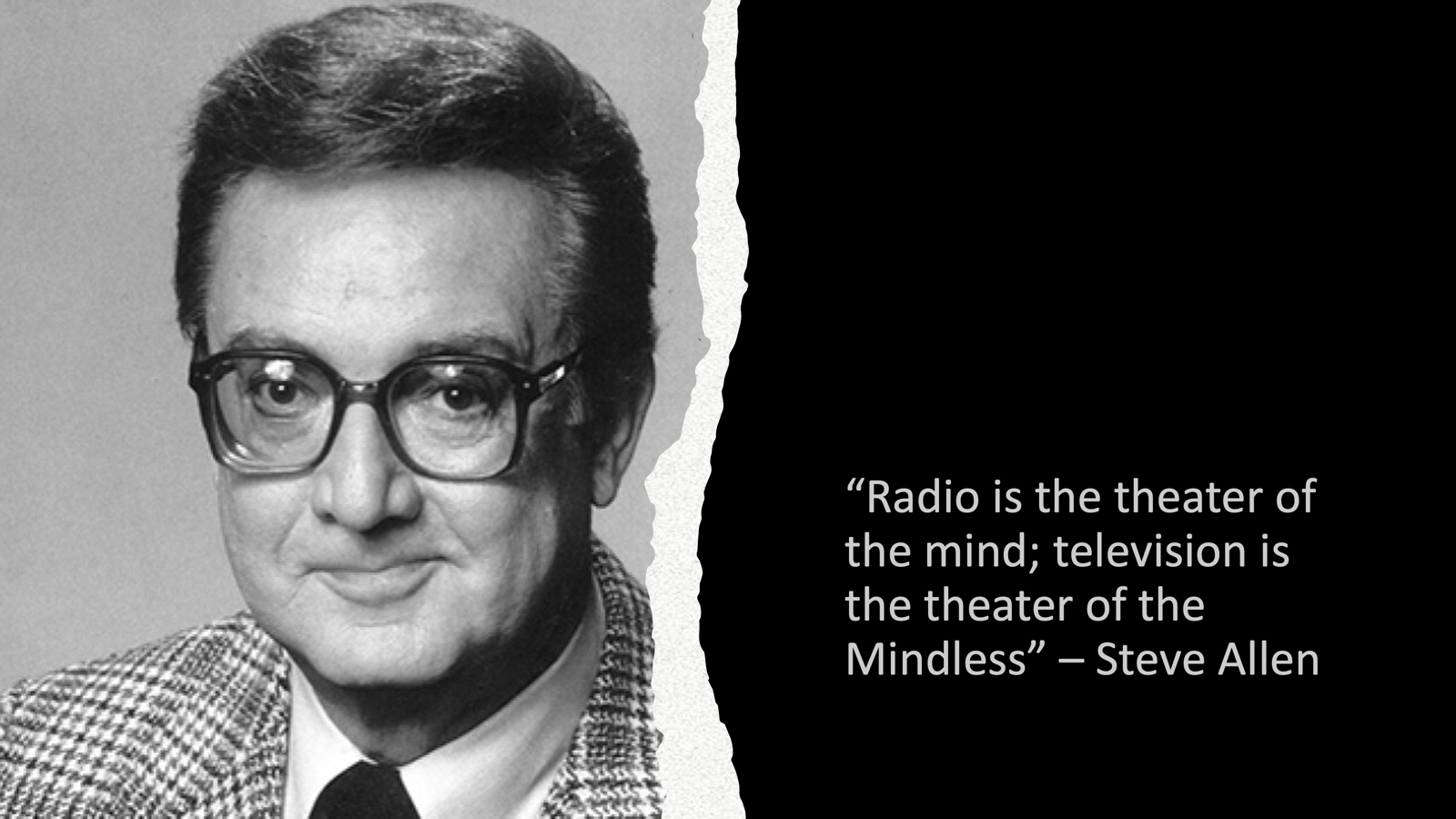
Radio in its prime was known as the Theatre of the Mind because the medium coaxed its audience to bring their imagination to the listening. It was an active relationship with the broadcast, unlike television, film, and theater, where the experience is passive – you sit back and let the experience wash over you, seeing exactly what the production team wants you to see. Not so radio at its best and most creative.
In fact, when network television was in its golden age and many programs it offered were recreations of radio shows, those original live broadcasts quickly encountered the difficulty of producing visually what radio had implied. How to create the image of what radio had been able to induce in the audience’s imagination? They had sound in common, but meeting expectations for believability required new sorts of stagecraft.
It’s tempting to speculate the state of the visual media today is the result of an ever evolving reliance on visual effects that began way back then in telling the story. Stagecraft, special effects, every sort of spectacle and now the ominous specter of artificial intelligence loom larger in the way we create our tales than does the story being told. Text today is almost incidental, the dialogue nearly incomprehensible; were it not for closed captioning, most of us would know the story only from visual cues. Style matters far more than substance and imagination is nearly moot.

Radio at its best creates an intimacy with its audience that the finest deejays can sustain over an entire career. There is something unique and enduring about the process of participating in an imaginary realm where the essentials of a story or even simply a mood are suggested and the listener fills in the blanks. The person at the microphone may lead you down the path, but you decide the shape and size and all the details of the world you’re passing through.
We write about the time of Freeform Radio because it exemplified the magic that radio brought us when freedom was demanded and creativity was expected. Listen to any of the air checks we’ve reengineered from reel to reel tapes into state of the art .wav files that are posted (HERE). They and all the supporting material, station IDs, live cast concerts, celebrity endorsements, the commercials, public service announcements, all of it is uniquely produced and respectfully presented to the audience.
Of course, very little of that creativity comes our way on the public airwaves today, where algorithms do the programming and sponsors decide what gets played when. Most of the remarkable radio talents are long since off the air and far too many have transitioned to the next realm with the relentless passing of time. People like Pierre Robert, who held sway at WMMR in Philadelphia for decades (HERE), are the last of a breed and we may never hear their like again. “My, my, my imagination,” as Chrissie Hynde sings, and Chrissie knows what matters when it comes to making art.