New Moon Edition August 2025
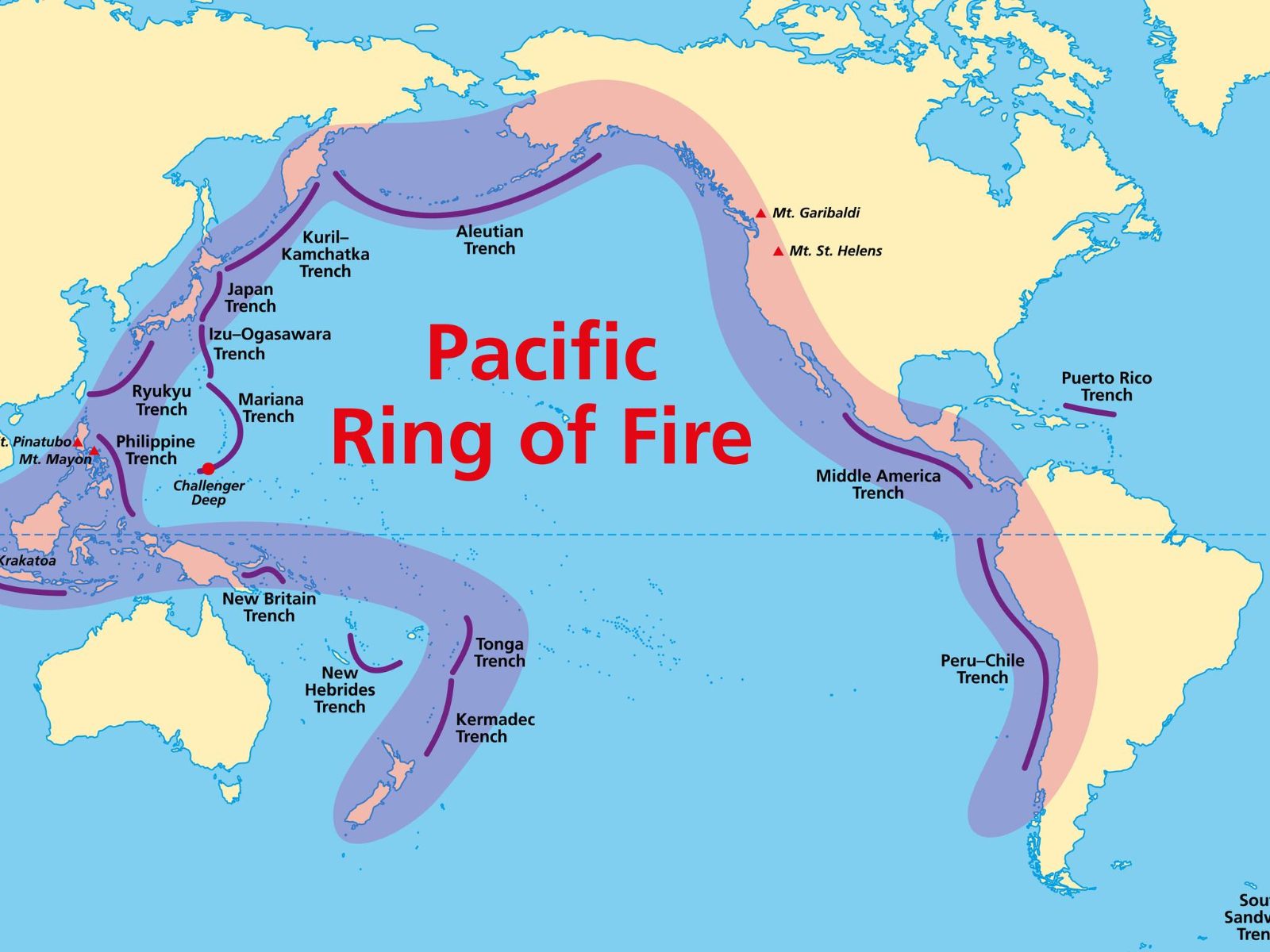
The Ring of Fire – the geologic one and not the Johnny Cash song – is a horseshoe-shaped belt along the edge of the Pacific Ocean where most of the earth’s volcanoes are located and most of the world’s severe earthquakes occur (HERE). Plate tectonics are the source of that activity, which in geologic time is frequent. It’s also home for a helluva lot of people who, living as we do so briefly in comparison, rarely if ever experience any of it. Beware though if we do.
Kathryn Shulz wrote The Really Big One in The New Yorker (HERE), which described a major earthquake and the resulting tsunami that once again will devastate the Pacific Northwest Coast as it did most recently in 1700. The Cascadia Subduction Zone fifty miles off shore in the Pacific and two miles below the surface stretches from Cape Mendocino to Vancouver Island. It has ruptured some forty times in the past 10,000 years, roughly once every 250 years. And it will again. It’s overdue.
When it does, it may well be the greatest natural disaster in history. What got people’s attention in Shulz’s article was FEMA’s regional director, Kenneth Murphy, who said: “Our operating assumption is that everything west of Interstate 5 will be toast.” That was written ten years ago when FEMA was still functioning, when we assumed as it always had the Federal Government would address the massive problem and finance its repair. In our current climate, one wonders what the response might be to such a devastation and how it might impact the country. How would we hold together?
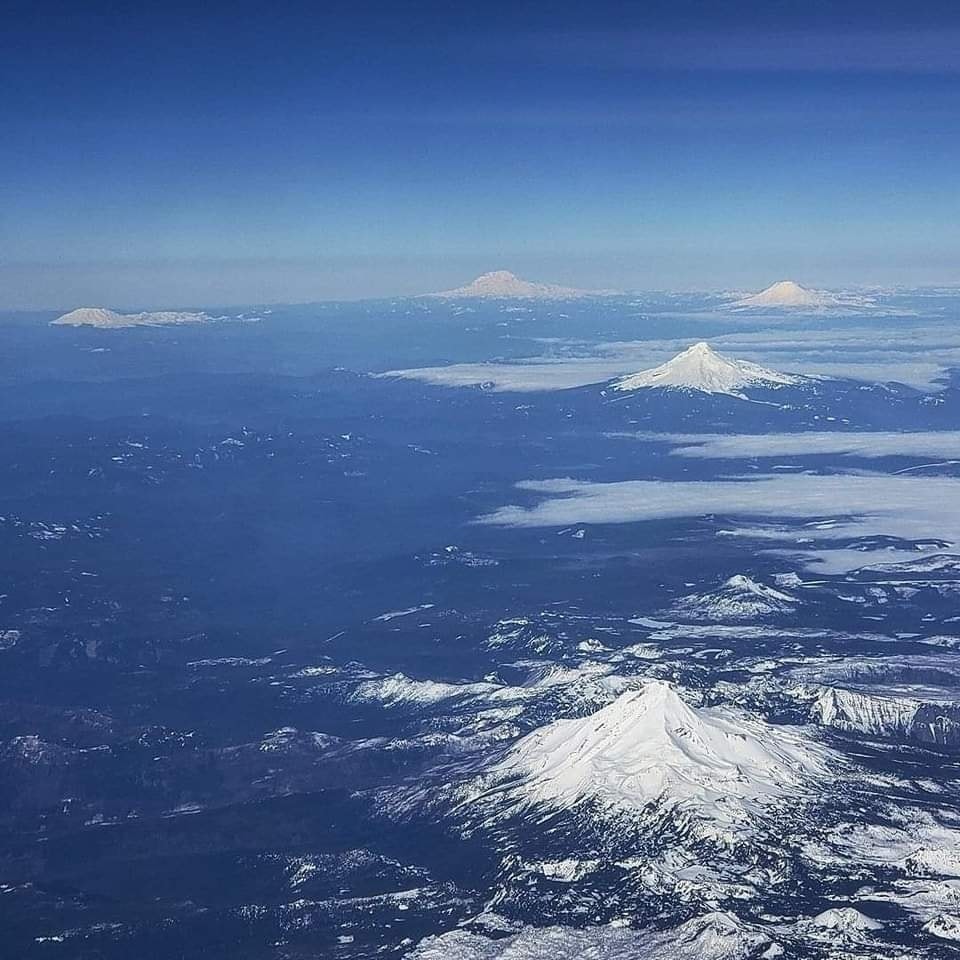
Four days after my birthday in May of 1980, Mt. St. Helens in Washington (top left) erupted in a plume of ash, gas, and a river of lava that blew the northeast face of the mountain away and devastated the immediate area. Fifty-seven people were killed, 200 homes, 47 bridges, 15 miles of railway, and 185 miles of highway were destroyed. The force of the explosion lowered the elevation of the mountain by more than 1200 feet. It was the most catastrophic volcanic eruption in U.S. history (HERE).
I awoke the next morning 700 miles away under an open window near Glacier Park, Montana covered in a fine layer of ash. I drove that day to Spokane in ash that grew progressively to six inches in depth as I headed West. The city was literally covered in grey powder. Breathing was painful after a short time and soon enough people were covering their faces in handkerchiefs and masks. We were warned to change the oil and filter in our car everyday, so business was brisk at service stations. Nonetheless, all the local police vehicles eventually suffered engine failure. My car fared no better.
The crops that Fall were excellent, enriched by the mineral content of the ash, auto sales were strong, and life for the survivors returned to normal. It was a regional disaster triggered by a magnitude 5.1 earthquake. The next Cascadia quake will be of 9.0 to 9.5 magnitude, some 400 times more powerful, and it will be accompanied by a tsunami in places 100 feet high. Whether volcanic eruptions are initiated remains to be seen but it is certain the death toll will be enormous and the destruction profound. If there is no FEMA, no other Federal support of a recovery, what might the result be?

I began writing the book Cascadia: A Future Fable of Destruction and Redemption in 2016, partly inspired by Shulz and largely out of curiosity about what it would take for the body politic in this country to wake from its somnambulistic march toward irrelevance as anything other than a market to be exploited. It seemed that a disaster might do it, but it would have to be a big one. The Cascadia Subduction Zone scaled.
Epic catastrophe gets our attention, at least for the moment, but the truer disaster is the subtle and persistent whittling away of our capacity to be active rather than passive, engaged instead of subsumed, a creator and not a consumer. What then would it take to pry us away from our devices, binge streaming, relentless shopping for stimulation, our earphone fog of isolation? What would it take to shake us from our virtual existence, I wondered? What could dissolve the miasma and open our eyes?
What if a calamity obliterated a prosperous corner of our country and reduced the entire populace to homelessness? And what if the federal government decided to cut them loose? What if the West Coast of the U.S. was cast adrift, jettisoned from the Union, and became a country unto itself? What if the disaster was so profound, the need so great, the pathway to redemption so desired, that all the contrived tropes supporting capitalism and our devotion to survival of the fittest could be overcome? What if the social contract mattered more? What would that be like? (HERE)